
Can Reforming Higher Ed From Within Fix What's Broken in K–12?
College is on the minds of many high schoolers, particularly this time of year. What are they seeking? Could they be looking to be challenged, to grow, and to have their ideas tested among the best and brightest?
Much has been written about collapsing academic standards, politicized classrooms, censorship, and student activists taking over college campuses. As trust in higher education has deteriorated, people are voting with their feet and wallets, and the landscape is changing.
Are high schools preparing students for college?
An effective, outspoken leader, Vanderbilt University Chancellor Daniel Diermeier, has been critical of high school cultures that “fail to cultivate intellectual resilience,” leaving students unprepared for the rigors of university-level open inquiry. Diermeier emphasizes that most incoming students are unprepared by their high schools for free expression and civil discourse and that universities must address it.
More specifically, Diermeier highlights:
A lack of conflict-resolution habits: Diermeier explicitly argues that high schools simply don’t prepare the students well for a culture of civil discourse. They fail to provide younger students with the tools or structural practice needed to disagree passionately while still maintaining deep personal respect for one another. As a result, students arrive at college fearful of being ostracized, socially excluded, or vilified for challenging prevailing viewpoints.
The breakdown of foundational trust: At its root, Diermeier views the high school environment as having an underlying “problem about trust.” Instead of fostering an atmosphere where students can safely disagree, high school cultures encourage self-censorship out of a lack of mutual trust.
As seen in Reform from Within: A Fireside Chat with Vanderbilt Chancellor Daniel Diermeier, courageous leaders like Diermeier are standing up for academic standards, rigor, and open debate. Hosted by the American Enterprise Institute (AEI), this event highlighted how institutions with strong leadership and clear values make real progress against a system that has been captured by ideological activism.
What does Vanderbilt do to address these deficits?
On February 25, 2025, leaders from Vanderbilt University and Washington University in St. Louis published a joint full-page ad in The Wall Street Journal titled “Higher Education is at a Crossroads.” The ad argued that ideological pressures—both inside and outside of college campuses—have pulled universities away from their core missions of open inquiry, learning, innovation, and discovery.
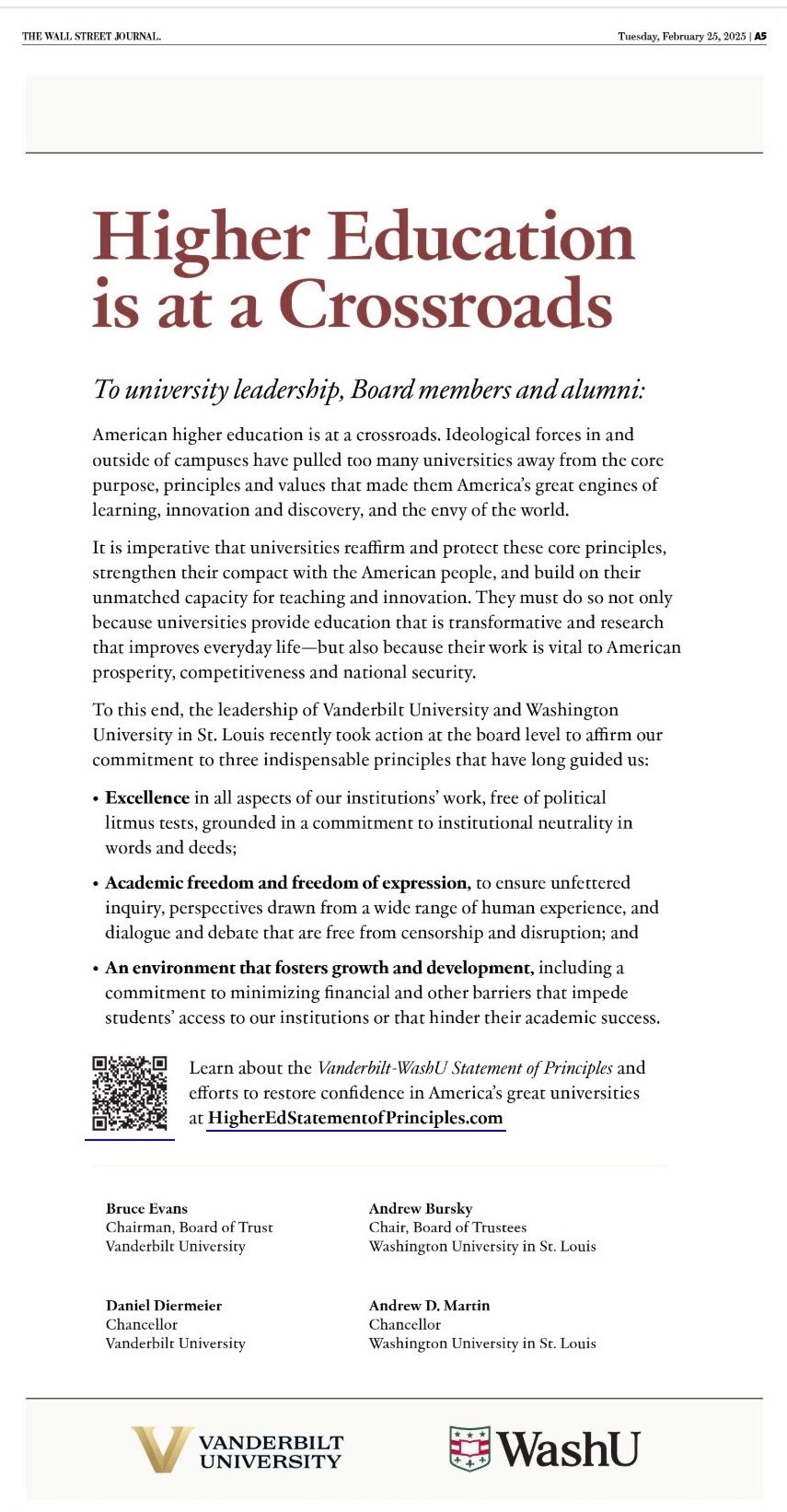
Vanderbilt doesn’t stop at advertising. From day one, students are introduced to a new framework of expectations and practices designed to instill these values and create habits that shape the university’s culture. These foundational practices include:
The “Day One” Reset: Because students lack these habits when they get to campus, Diermeier argues that universities must actively train them. At Vanderbilt, this requires an extensive, intentional program that starts on day one and continues for months.
The Community Creed: To counter the lack of preparation, incoming Vanderbilt students are required to sign a student-written “Community Creed” upon arrival. This pledge commits them to mutual respect, active listening, and a refusal to immediately vilify or isolate peers who hold differing viewpoints.
Dialogue Vanderbilt: To build the necessary trust and skills that high schools missed, the university relies on Dialogue Vanderbilt. This initiative provides deliberate programming, student facilitators, and structured debate spaces to teach students how to argue using facts and handle complex disagreements.
Because of the systemic gaps in high school preparation, Diermeier has stated that universities are forced to run intensive “re-education” or orientation programs just to teach freshmen how to have a basic, constructive conversation. To actively combat this trend, Vanderbilt partnered with independent secondary institutions to launch the Open Dialogue Collaborative Summit, explicitly aimed at restructuring high school cultures before students ever reach a college campus.
Is anyone surprised by Vanderbilt’s ascendance?
Vanderbilt University has experienced a meteoric rise in popularity. It has become one of the most competitive and highly sought-after private research universities in the United States. A decade ago, the university received approximately 31,400 applications; for the Class of 2030, that number surged to a record-breaking 54,000-plus, complemented by an equally strong yield rate of 63.1%.
How is this working? Follow the money.
The recent Vanderbilt “Dare to Grow” fundraising campaign raised $4.5 billion from some notable donors, including:
Jensen and Lori Huang ($75 Million): To establish the Jen-Hsun and Lori Huang College of Art, Architecture and Design
Tom Golisano ($40 Million): To fund the Golisano Pediatric Heart Institute
John and Shannon Addison ($30 Million): To kickstart the School of Engineering’s new state-of-the-art science building
Michael and Allison Rees ($25 Million): To establish the Vanderbilt Undergraduate Center for Finance
Thomas R. Walters ($10 Million): To establish Walters Family Defense Tech Innovation Accelerator Fund
James Patterson ($10 Million): To create Patterson Institute for Early Adolescent Literacy
Stephen M. Ross ($50 Million): To anchor investment for the Palm Beach campus
Bill Ackman ($25 million): To create an endowment
A Call to Action
Parents Unite was founded to confront the decline of viewpoint diversity and intellectual rigor in K-12 independent schools. These institutions, which feed higher education, once dedicated to the pursuit of truth, civil discourse, and high standards, have lost their way due to fear and unaccountable leadership. As a result, the students are not entering college prepared to tackle some of the greatest challenges. It is time for trustees to face the realities of destructive educational trends and reclaim their schools’ founding principles. Look to Vanderbilt for inspiration and visit our Take Action page for practical tips to get started. Parents, school leaders, and educators must find the courage to stand up for what matters—even in the face of criticism. The future of independent education depends on our willingness to engage and defend its core values.
Thanks for reading Parents Unite! Subscribe to our Substack for free to receive new posts and support our work.