
Is Bates College any different from the elite independent schools that feed it?
In a recent Atlantic article Why I Quit The Tenure Track: The insufferable hypocrisy of elite academia, Tyler Austin Harper provides a firsthand account of what woke infiltration does to institutions that have allowed it to take over. He exposes how elite institutions leverage progressive, “woke” ideology to conceal economic exploitation and how administrations may adopt DEI initiatives and progressive rhetoric to protect institutional wealth while suppressing labor, a phenomenon he describes as “inclusive exclusion.”
According to Harper, “Wokeness allowed elite higher ed to create a new model of inclusive exclusion: one in which tuition can continue to climb, acceptance rates can continue to plummet, endowments can continue to expand, and adjunct labor can continue to be exploited as long as the demographics of those paying the tuition and those being exploited continued to get browner, Blacker, more LGBTQAIP2+. If my time at Bates had taught me anything, it was that the most reliable way to get progressive white academics to do what you wanted was to translate your concerns into the therapeutic language of racial harm.”
Why pay attention to Bates?
While his article is about Bates College and tenure, there are many parallels to K-12 independent schools, particularly those that feed schools like Bates.
Bates serves as an interesting example because of who they serve. The school covets identity-based diversity, but lacks viewpoint and socioeconomic diversity. According to publicly available data, roughly 49% of enrolled students at Bates come from independent/private high schools (with characteristics similar to those of small liberal arts colleges). This is driven by Bates’ deep historical recruiting pipelines with prestigious New England prep schools and elite independent schools nationwide.
According to the New York Times college mobility study, Bates ranks among the highest in the nation in wealthy student concentration but lower in upward economic mobility. Bates historically ranks among the least economically diverse elite colleges in the United States, consistently ranking at or near the very bottom among elite U.S. institutions for its share of lower-income students.
The Bates Student Newspaper explains, “As for the student experience of economic diversity, many feel an unspoken socioeconomic divide on campus, as well as a misalignment in the values and practices of the college.”
Bates (as do the many independent schools that feed it) prioritizes social justice, but who does this help?
According to Harper, 5 years ago, Bates required “every department and program to complete a racism self-audit, to “napalm the strangling weeds of bigotry that were apparently rooted deep in its soil.” The goal of this project, innocuously called Foundational Dialogues, was to identify areas where white supremacy, “colonial” frameworks, and other forms of bias might be lurking in curricula and major requirements.”
Because “the work is never done,” Bates, like most independent schools, continues to have an Office of Equity and Inclusion (hammers looking for nails) obligated to be “committed to the principles of social justice, equity, and freedom.”
How does this “work” impact the student, aka the “customer” learning experience?
In the 2026 College Free Speech Rankings published by the Foundation for Individual Rights and Expression (FIRE), Bates College ranks 226th out of 257 schools, earning a speech climate grade of “F.” Bates College placed at the bottom of the New England Small College Athletic Conference (NESCAC). Some of the reasons:
Bates lacks a formal commitment to institutional neutrality. This means school administrators frequently release official corporate stances on polarizing cultural or political events, which critics say establishes a “correct” campus orthodoxy and pressures dissenting viewpoints into silence.
There is a dramatic political imbalance. Student survey data indicate political polarization on campus, with liberal undergraduates outnumbering conservative peers by roughly a 14-to-1 ratio. Based on the total enrollment of 1,760, there are approximately 1,643 liberal students and 117 conservative students at Bates College.
When The Bates Student polled the entire campus community regarding party registration and presidential voting plans, the results further detailed the ideological distribution—80% of the overall Bates community registered as Democrats, while only 6% registered as Republicans.
Because of the intense social imbalance, 31% of Bates students admit to regularly self-censoring their personal views at least once or twice a month, out of fear of social isolation or academic peer judgment.
What have we learned from this story?
In May 2021, several months before Bates embarked on its racism and equity audit, independent schools were already moving full steam ahead on their racism and equity audits-often conducted by specialized external firms from the NAIS playbook, such as The Glasgow Group—to evaluate campus climates, curricula, and institutional policies.

One event is worth remembering. At an ISM (Independent School Management)-sponsored virtual conference, “Navigating DEI in a Divided Landscape,” hosted by The Dalton School, participants dismissed parents’ concerns about critical race theory, discussed excluding dissenting parents, and considered manipulating school boards by limiting trustee eligibility. Consultants also disparaged traditional curricula and suggested expelling students whose parents opposed critical race theory.
Despite pushback, these audits typically led to concrete, structural shifts in how independent schools operate across some primary categories:
De-leveling and curriculum overhauls
The creation of identity-based affinity groups
Changes in discipline and student support
Overhauls to hiring, admissions, and financial aid
Reshaping board governance and institutional policies
5 years later, has anything improved?
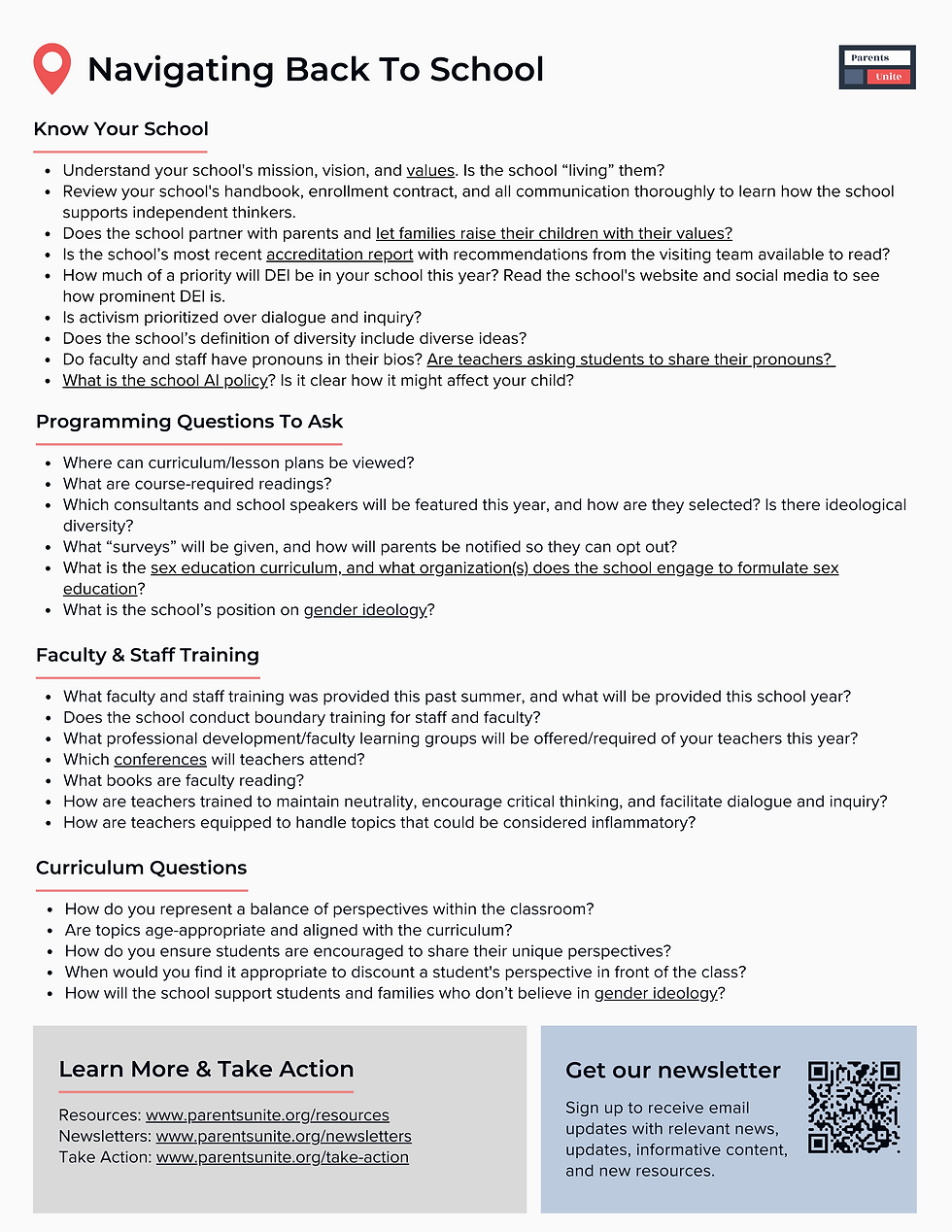
As you prepare for back-to-school, it might be helpful to review your school’s DEI plan and consider the following:
Has the school demonstrated measurable student learning outcomes resulting from the time and money it has spent on DEI?
Is your school and its DEI crew continuing to double down on DEIJB+, or is it quietly rebranding/diluting DEI language? A clue would be to see if the same proponents are still at school, but using different words like belonging, community, inclusion, etc.
What would happen to a student who expresses a different viewpoint in or outside of class?
Are families/teachers who don’t subscribe to the woke orthodoxy welcome at school?
Who are the speakers coming to campus this year?
For more ways to assess your school, view our Navigating Back To School one-sheet:
Thanks for reading Parents Unite! Subscribe to our Substack for free to receive new posts and support our work.