
Teaching Turtle Island
There was scant media coverage of the far-left, anti-government extremist group Turtle Island Liberation Front (TILF) and its attempted New Year’s Eve bombing of two U.S.-based companies in Southern California. TILF promotes anti-American, anti-Israel, and anti-capitalist views, alongside calls for decolonization. Their Instagram account is revealing.
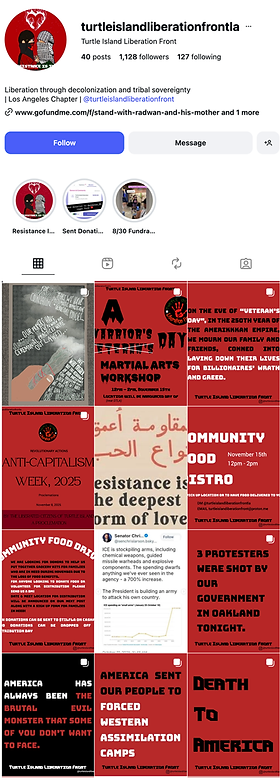
What does this have to do with school?
To better understand the anger growing among young people, we turn to a recent article entitled “Toxic Ideas Fueling Far-Left Terrorists Came Straight from Our College Campuses,” by William A. Jacobson and Kemberlee Kaye. In this article, Jacobson and Kaye explain that intersectionality—commonly taught in K-12 independent schools as part of DEI—is a toxic ideology that “pits people against each other based on group identity.”
They go on to state that “we’d better start paying attention — because intersectionality fuels the coalition of leftists, anarchists and Islamists intent on tearing down our country.”
Students are being indoctrinated and not educated. They are fed a steady diet of negativity, division, and ideological homogeneity intended to dismantle the Western canon. We are seeing the results of this incessant focus on identity and social justice activism.
Is your school still teaching divisive and harmful ideology?
Five years ago, Cessa Lewis ’23, a student at St. Luke’s School in New Canaan, CT, wrote an article for her school newspaper titled, “What SDLC Taught Me (And Why It’s Time to Rename America).” Her account of the four-day virtual NAIS Student Diversity Leadership Conference (SDLC) provides an instructive glimpse into how students have been activated by ideology, suffocating empathy, and white guilt.

“A group of 500 of us participated in an experience similar to the fishbowl, where you turned on your camera when you could speak from the “I” perspective of any of the identifiers called. These identifiers included race, gender identity, sexual orientation, household income, family structure and age. This was a nerve-wracking experience. I generally don’t identify myself through my religion or sexual orientation, and I was anxious about doing it in such a public way. Even more uncomfortable was the instruction to reveal my household income. As a person of privilege, I’m aware that I am in an income bracket that few Americans are. I suddenly had a disturbing vision of my face being the only one on the screen. I heaved a sigh of relief when the screen was filled with diverse faces, which only served as a mirror for me of my own misconception and revealed I need to have a broader view of what wealth looks like.”
“After the keynote speaker, I Zoomed into my White Affinity Accountability and Awareness group, where we discussed how best to advocate for our BIPOC friends and community. One of the leaders said, “The beauty of anti-racism is the commitment to fight racism wherever you find it, even in yourself. You don’t need to be free of racism to be an antiracist.” What I gleaned from this experience is that privilege isn’t only evident in the clothes you wear or the house you live in. It’s that sense of belonging, and the feeling that you are meant to be in every room you enter.”
Although the article was written five years ago—and despite DEI having since been widely questioned and debunked—the St. Luke’s School website shows that its commitment to DEI remains unchanged, much like most other independent schools.
When we come to understand the goals of social justice warriors and those of the Turtle Island movement, it naturally raises questions about whether these beliefs are developmentally appropriate or educationally beneficial for students.
Should impressionable young minds be aware of an educator’s personal beliefs?
Does the school allow lesson content to be kept from parents?
If the school endorses these teaching methods, what kind of classroom experience does that encourage?

As an example, we learned that Milton Academy not only has a teacher affiliated with Turtle Island, but last year its 6th-grade English classes were assigned Turtle Island reading materials intended to be completed in class and not shared with parents.


These teaching methods are not exclusive to independent schools. Here is an example of an organization that provides professional development to educators:

“XITO is a grassroots, urban education consulting collective and non-profit organization committed to training teachers, school districts, and higher education institutions in decolonial and re-humanizing pedagogies and curriculum development.”
To learn more about XITO, take a look at their upcoming 3-day summit, “SUMUD IN PRAXIS: Teaching for Solidarity from Turtle Island to Palestine.” This summit aims to “make connections between settler colonial projects, land dispossession and cultural resilience from Turtle Island to Palestine.” They even sell merch.

Is the first step in solving a problem, admitting a problem?
Most K-12 schools have been producing conformist social justice activists, not independent thinking truth seekers, which is why students are showing up on college campuses already indoctrinated into anti-Western views. Once students get to college, they enter classrooms inhospitable to diverse perspectives.
A recent Harvard Crimson article highlights a podcast on which Harvard President Garber Faults Faculty Activism for Chilling Campus Debate and Free Speech.
“Garber appeared to tie many of higher education’s oft-cited ills — namely, a dearth of tolerance and free debate — to a culture that permits, and at times encourages, professors to foreground their identity and perspectives in teaching.”According to President Garber, “We’re not about the activism. We’re not about pushing particular points of view,” he said. “You should be logical, firmly grounded in the evidence and rigorous in how you approach these issues.”
How will Harvard prioritize objectivity in the classroom? How will faculty be held to account? And if they are successful in doing so, can we expect these new expectations to trickle down to the K-12 schools that feed these colleges?
Thanks for reading Parents Unite! Subscribe to our Substack for free to receive new posts and support our work.